What Age Should a Child Start Preparing for the 11 Plus Exam?
 Bullseye Academy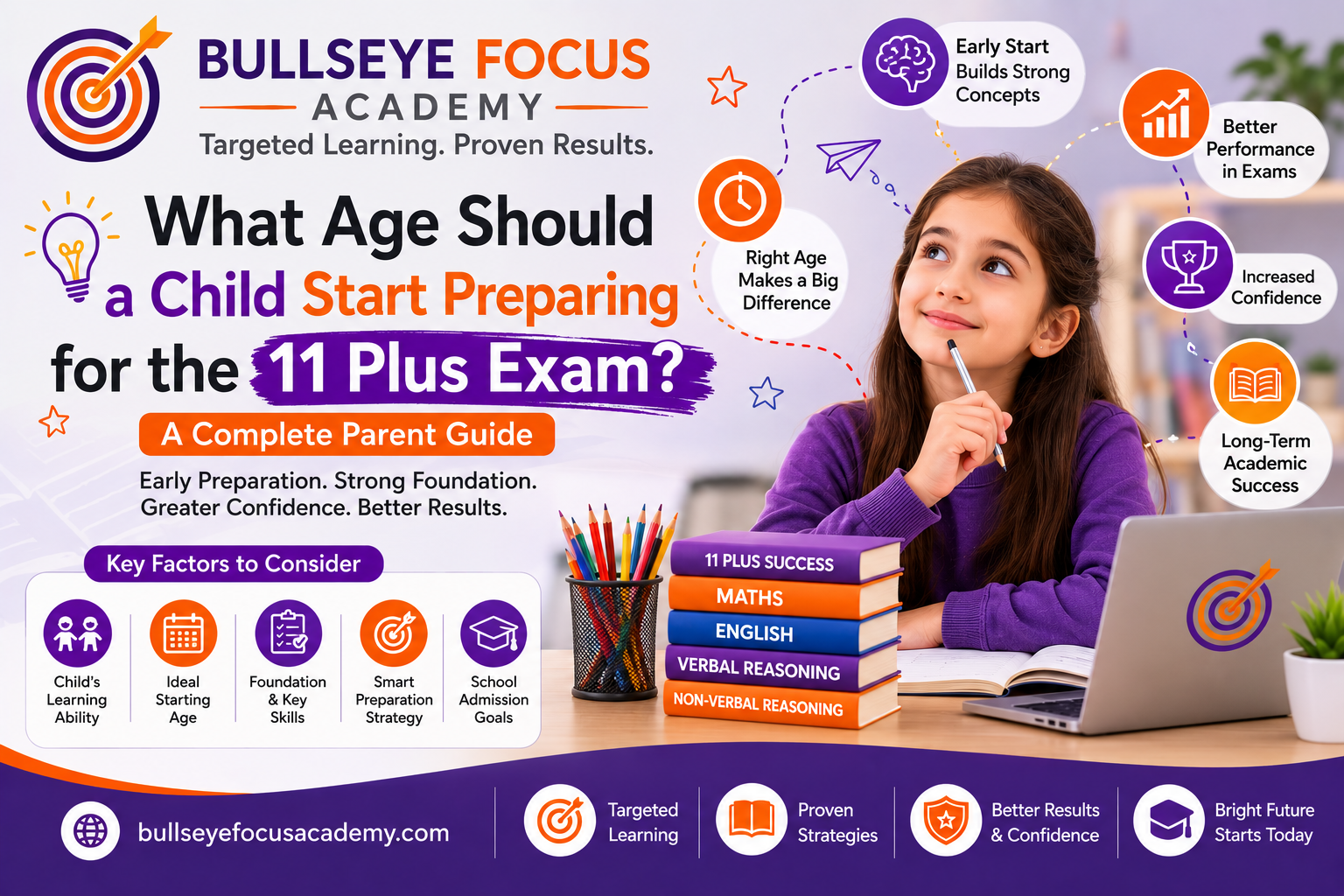
# What Age Should a Child Start Preparing for the 11 Plus Exam?

## What Age Should a Child Start Preparing for the 11 Plus Exam?
11 Plus Preparation Age is one of the most common concerns for parents considering grammar school admissions. Many families wonder when preparation should begin, how early is too early, and what timeline gives children the best chance of success. Understanding the right 11 Plus Preparation Age helps parents create a balanced study plan that develops confidence, academic skills, and exam readiness without causing unnecessary pressure. Understanding the correct 11 Plus Preparation Age helps parents create a realistic study plan that balances learning, confidence, and exam readiness.
One of the most common questions parents ask when considering grammar school applications is what age a child should start preparing for the 11 Plus exam. The answer is important because starting too early can create unnecessary pressure, while starting too late may leave insufficient time to develop the skills needed for success. Many families worry about choosing the right 11 Plus Preparation Age, especially when comparing their child’s progress with other students.
Many parents worry that other children have already begun preparing and that their child may fall behind. However, successful preparation is not about starting first. It is about starting at the right time and following a structured approach that matches the child’s individual needs and development.
The 11 Plus exam is designed to assess academic potential rather than simply test memorized knowledge. Students are often evaluated on English, Mathematics, Verbal Reasoning, and Non-Verbal Reasoning. Strong preparation helps children become familiar with these areas while developing confidence and exam technique.
Parents looking for structured learning support can explore the following:
[https://bullseyefocusacademy.com/](https://bullseyefocusacademy.com/)
Preparation resources are available at:
[https://bullseyefocusacademy.com/shop/](https://bullseyefocusacademy.com/shop/)
### Why Timing Matters in 11 Plus Preparation
The age at which preparation begins can influence a child’s experience significantly. If preparation starts too early and becomes intensive, children may lose motivation before the exam arrives. On the other hand, beginning too late can result in stress and rushed learning. The ideal 11 Plus Preparation Age allows children to build skills gradually without feeling overwhelmed.
The ideal preparation timeline allows students to:
- Build skills gradually
- Develop confidence steadily
- Avoid excessive pressure
- Improve reasoning abilities naturally
- Maintain a positive attitude toward learning
Children learn most effectively when preparation feels manageable rather than overwhelming. Choosing the right 11 Plus Preparation Age often leads to better long-term academic development and reduced exam stress.
### The Most Common Starting Age
Most educational specialists suggest that formal 11 Plus preparation begins between the ages of 8 and 10, typically during Year 4 or early Year 5. Educational experts generally agree that the recommended 11 Plus Preparation Age falls between 8 and 10 years old.
This timeframe provides several advantages:
- Sufficient preparation time
- Opportunity to strengthen weak areas
- Gradual development of reasoning skills
- Reduced last-minute pressure
- Better retention of knowledge
Many successful students begin structured preparation around Year 4 and increase their focus gradually as the examination approaches. Starting at the appropriate 11 Plus Preparation Age gives students enough time to strengthen key academic skills.
### What Children Should Learn Before Formal Preparation
Before beginning focused exam preparation, children should develop strong foundational skills.
Important areas include:
#### Reading Confidence
Regular reading improves vocabulary, comprehension, and communication skills. Children who enjoy reading often perform better in English and verbal reasoning assessments.
#### Basic Mathematics
Strong understanding of core mathematical concepts provides a foundation for more advanced problem-solving questions.
#### Curiosity and Learning Habits
Children who enjoy learning and asking questions often adapt more effectively to exam preparation.
#### Concentration Skills
The ability to focus for sustained periods becomes increasingly important as the exam approaches.
Building these foundations before formal preparation often produces better long-term results.
### Age 7 to 8: Building Foundations
At this stage, preparation should be gentle and focused on developing fundamental skills.
Parents can encourage:
- Daily reading
- Vocabulary development
- Mental arithmetic
- Educational games
- Puzzle solving
There is generally no need for intensive exam practice at this age. Instead, the focus should remain on creating positive learning experiences and building strong foundations at the appropriate 11 Plus Preparation Age.
### Age 8 to 9: Introducing Key Skills
This age often marks the beginning of more structured preparation.
Children can begin:
- Verbal reasoning exercises
- Non-verbal reasoning activities
- More challenging reading comprehension
- Problem-solving tasks
- Timed learning activities
The goal is to introduce relevant skills gradually without creating unnecessary stress.
### Age 9 to 10: Structured Preparation
For many families, this is the ideal stage to begin formal preparation.
Students can start:
- Practice papers
- Subject-specific revision
- Timed exercises
- Vocabulary building programmes
- Regular study schedules
At this point, preparation becomes more targeted while remaining balanced and manageable.
### Why Every Child Is Different
Although many parents focus on finding the perfect age, individual differences are often more important than exact timing.
Factors influencing readiness include:
- Academic ability
- Learning style
- Confidence levels
- Reading habits
- Motivation
- School performance
Some children may be ready for structured preparation earlier, while others benefit from waiting slightly longer. Parents should focus on their child’s individual development rather than comparing them with others. While guidance exists, the best 11 Plus Preparation Age depends on each child’s confidence, maturity, and learning style.
### Signs Your Child Is Ready to Begin Preparation
Several indicators suggest that a child may be ready for more structured learning and has reached the appropriate 11 Plus Preparation Age for beginning formal exam preparation.
These include:
- Strong reading skills
- Interest in problem-solving
- Ability to concentrate independently
- Positive attitude toward learning
- Willingness to complete practice activities
Children showing these signs often adapt well to structured preparation plans.
### Common Concerns Parents Have
Many parents worry about making mistakes when deciding on the right 11 Plus Preparation Age and creating an effective study plan for their child.
Common concerns include:
#### Starting Too Late
Parents often fear their child will fall behind competitors.
#### Creating Too Much Pressure
Families want to support success without causing stress.
#### Choosing the Right Resources
The variety of preparation materials available can feel overwhelming.
#### Balancing School and Preparation
Parents want to maintain healthy routines while supporting academic development.
These concerns are normal and can be addressed through careful planning and realistic expectations.
### The Benefits of Starting at the Right Age
When preparation begins at the right 11 Plus Preparation Age, students often experience several academic and confidence-building advantages.
These inclu
This brief was generated from the original reporting. Read the full article at the source:
Read at bullseyefocusacademy.com