All news

11 Plus vs 13 Plus Exam: What Is the Difference?

Bullseye Academy··14 min read·Bullseye Academy logoBullseye Academy
11 Plus vs 13 Plus Exam: What Is the Difference?
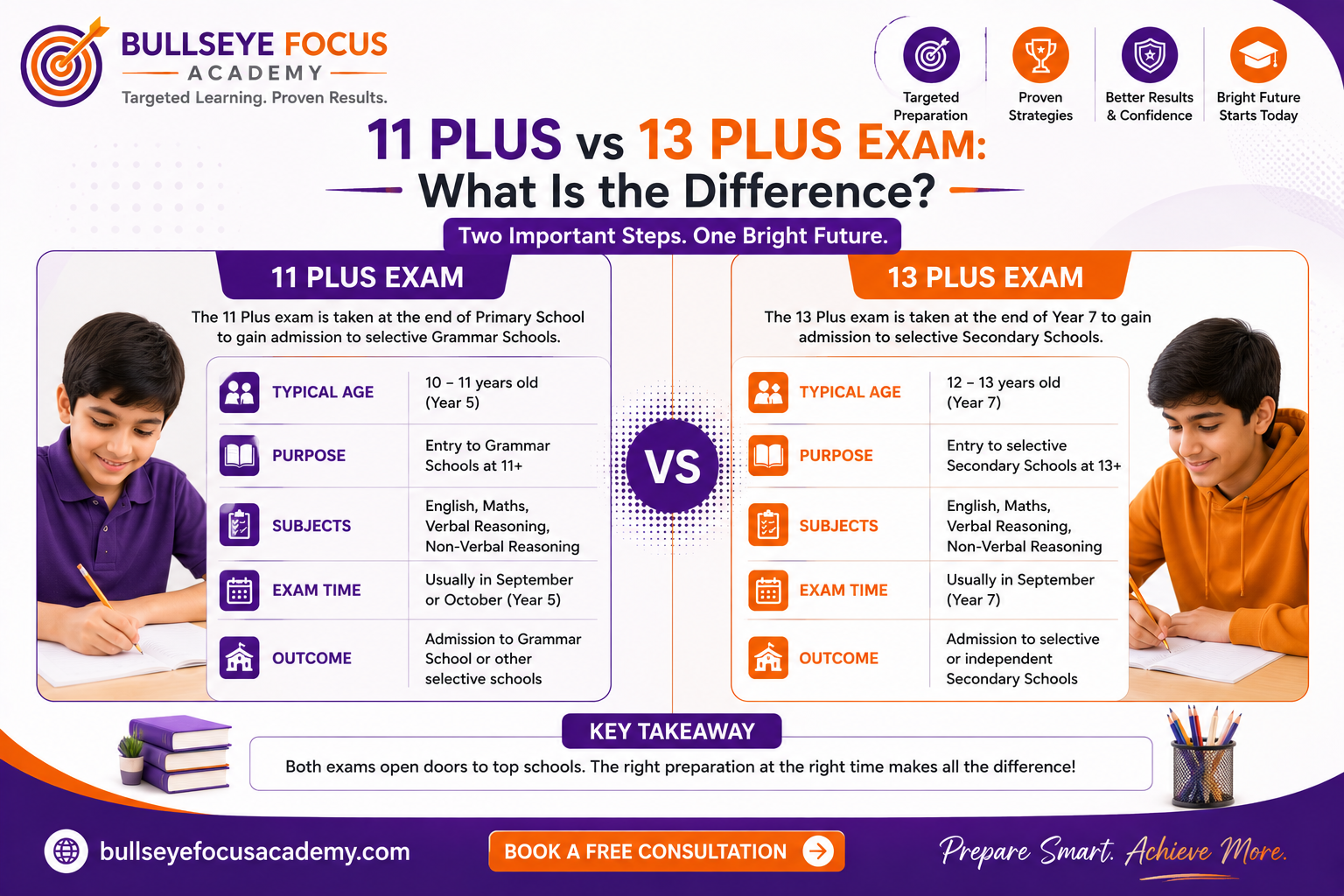
# 11 Plus vs 13 Plus Exam: What Is the Difference? ![11 Plus vs 13 Plus comparison for parents](https://bullseyefocusacademy.com/wp-content/uploads/2026/07/11-Plus-vs-13-Plus-Exam-Comparison.png) ## 11 Plus vs 13 Plus Exam: 9 Key Differences Every Parent Should Know Choosing the right entrance exam is one of the biggest decisions parents make when planning their child’s education. Many families researching grammar schools and independent schools often compare the 11 Plus vs 13 Plus because both examinations provide opportunities for admission into selective schools. Although the two exams have similar goals, they differ in terms of entry age, curriculum, preparation time, difficulty level, and the schools that use them. Understanding the differences between the 11 Plus vs 13 Plus helps parents make informed decisions based on their child’s academic ability, confidence, and long-term educational goals. Rather than assuming one examination is better than the other, it is important to understand which pathway is most suitable for each individual student. The 11 Plus examination is generally taken for entry into Year 7, while the 13 Plus examination is commonly used for admission into Year 9 at many independent schools. Both assessments evaluate academic potential, but they are designed for different stages of a child’s educational journey. Parents who understand the structure, expectations, and preparation requirements of 11 Plus vs 13 Plus are better equipped to support their children throughout the admission process. Understanding 11 Plus vs 13 Plus helps parents choose the most suitable educational pathway based on their child’s academic progress, confidence, and future school goals. Families looking for structured preparation programs can explore: [https://bullseyefocusacademy.com/](https://bullseyefocusacademy.com/) Practice materials and learning resources are available at: [https://bullseyefocusacademy.com/shop/](https://bullseyefocusacademy.com/shop/) ### Why Parents Compare 11 Plus vs 13 Plus Parents frequently compare the 11 Plus vs 13 Plus because they want to choose the best educational route for their child. Some students are ready to move into selective education at the age of eleven, while others benefit from having additional time to develop academically before taking entrance examinations at thirteen. Several factors influence this decision, including: - Academic readiness - Confidence levels - School preferences - Long-term educational goals - Availability of grammar or independent schools - Individual learning style Rather than viewing the examinations as competitors, parents should consider them as different opportunities that suit different students. Choosing the appropriate examination allows children to prepare with confidence and perform at their highest potential. Every family approaches 11 Plus vs 13 Plus differently because every child’s learning journey, strengths, and school preferences are unique. ### What Is the 11 Plus Exam? The 11 Plus examination is an entrance assessment used by many grammar schools and some independent schools for admission into Year 7. The examination usually takes place during Year 6, although preparation often begins much earlier. Depending on the school or examination provider, the assessment may include: - English - Mathematics - Verbal Reasoning - Non-Verbal Reasoning - Creative Writing (at some schools) The main objective is to identify students with strong academic ability and potential for success in a selective learning environment. Because grammar school places are limited, competition is often high, making structured preparation extremely important. ### What Is the 13 Plus Exam? The 13 Plus examination is generally used by independent schools for admission into Year 9. Unlike the 11 Plus examination, students have two additional years of secondary education before sitting the assessment. During this time, they continue developing subject knowledge and academic maturity. The examination may include: - English - Mathematics - Science - Verbal Reasoning - Non-Verbal Reasoning - Humanities (depending on the school) Some schools may also require interviews, school reports, or additional assessments as part of the admission process. The exact format varies between schools, so parents should always check individual admission requirements. ### Official Information About Entrance Assessments Parents who would like to understand more about assessment providers and educational testing can visit the official GL Assessment website: [https://www.gl-assessment.co.uk/](https://www.gl-assessment.co.uk/) Official school websites also provide detailed admission criteria, examination dates, and preparation guidance. ### Difference 1: Entry Age The most obvious distinction in 11 Plus vs 13 Plus is the age at which students take the examination. #### 11 Plus Students usually sit the examination at the age of 10 or 11 for entry into Year 7. #### 13 Plus Students generally take the examination at the age of 12 or 13 for entry into Year 9. These two additional years allow students to gain further academic knowledge and personal maturity before taking the assessment. ### Difference 2: School Entry Point Another important comparison in 11 Plus vs 13 Plus is the year of school entry. Students who pass the 11 Plus examination typically begin their new school in Year 7. Students who pass the 13 Plus examination usually join their chosen independent school in Year 9. This difference affects not only admission timing but also the amount of preparation available before the examination. ### Difference 3: Types of Schools The schools using each examination also differ. #### Schools Using the 11 Plus The 11 Plus examination is commonly used by: - Grammar schools - Some independent schools - Academically selective schools #### Schools Using the 13 Plus The 13 Plus examination is mainly used by: - Independent schools - Private schools - Boarding schools Some schools may accept both examinations depending on their admission policies. Parents should research individual schools carefully before beginning preparation. ### Difference 4: Subjects Included The subjects tested provide another important comparison in 11 Plus vs 13 Plus. The 11 Plus examination generally focuses on core academic skills and reasoning ability. Typical subjects include the following: - English - Mathematics - Verbal Reasoning - Non-Verbal Reasoning The 13 Plus examination often covers a broader curriculum because students are older. Additional subjects may include: - Science - History - Geography - Modern Languages The exact subjects vary between schools, making it important to review admission information carefully. ### Difference 5: Academic Difficulty One of the most common questions parents ask is whether one examination is more difficult than the other. The answer depends on how difficulty is measured. The 11 Plus examination challenges younger students through reasoning questions and strict time limits. The 13 Plus examination often requires deeper subject knowledge because students have completed additional years of education. Rather than comparing overall difficulty, it is more accurate to say that both examinations are challenging for their respective age groups. Students are assessed according to the expectations appropriate for their stage of education. ### Which Examination Should Parents Choose? The decision should never be based solely on perceived difficulty. Instead, parents should consider: - Academic ability - Learning style - Confidence - Preferred schools - Educational goals - Individual development Some children are ready for selective education at eleven, while others benefit from additional academic growth before taking entrance examinations at thirteen. There is no universally correct choice. The best option is the one that matches the child’s individual strengths and futur
Share

This brief was generated from the original reporting. Read the full article at the source:

Read at bullseyefocusacademy.com

More from Bullseye Academy

Related coverage