Software company
product
PAMM vs MAM vs Copy Trading: Full Comparison for Multi-Asset Brokers

# PAMM vs MAM vs Copy Trading: Full Comparison for Multi-Asset Brokers
Basics
Minimize operational risks
Mitigate dealing risks

_This article breaks down PAMM vs. MAM vs. copy trading, shows where each model fits, and helps you decide which option, or combination, makes sense for your brokerage._
Retail trading is tough for traders and for brokers. Regulatory data from ESMA and the CFTC shows that **[75–89% of retail trading accounts](https://www.fxstreet.com/education/why-do-most-retail-traders-fail-and-what-can-i-do-to-improve-my-chances-of-success-202503311406)** lose money, often within the first few months. If you run a brokerage, you see the impact every day. **[Nearly 40% of traders](https://tradeciety.com/24-statistics-why-most-traders-lose-money)** stop trading within their first month, around 80% quit within two years, and in any given quarter, only **[20–30% of retail accounts](https://contentworks.agency/understanding-forex-trader-psychology-to-prevent-churn/#:~:text=September%2015,%202025,churn,%20and%20build%20stronger%20retention.)** are profitable. That translates into short client lifecycles and constant pressure to replace inactive users rather than build stable, recurring trading volume.
This is precisely why money management models, such as **[PAMM](https://brokeree.com/solutions/mt4-mt5-pamm/)**, **[MAM](https://brokeree.com/news/simplified-mam-update/)**, and **[copy trading](https://brokeree.com/articles/what-is-copy-trading/)**, exist. All three keep traders engaged by connecting them to strategies of proven professional traders. But these systems operate in very different ways. They differ in how trades are executed, how risk is handled, and how much control your clients retain. For multi-asset brokers, those differences directly affect infrastructure load, compliance exposure, and revenue potential.
## **How Does PAMM, MAM, and Copy Trading Work?**
- ### **PAMM: Pooled Capital, Centralised Execution**

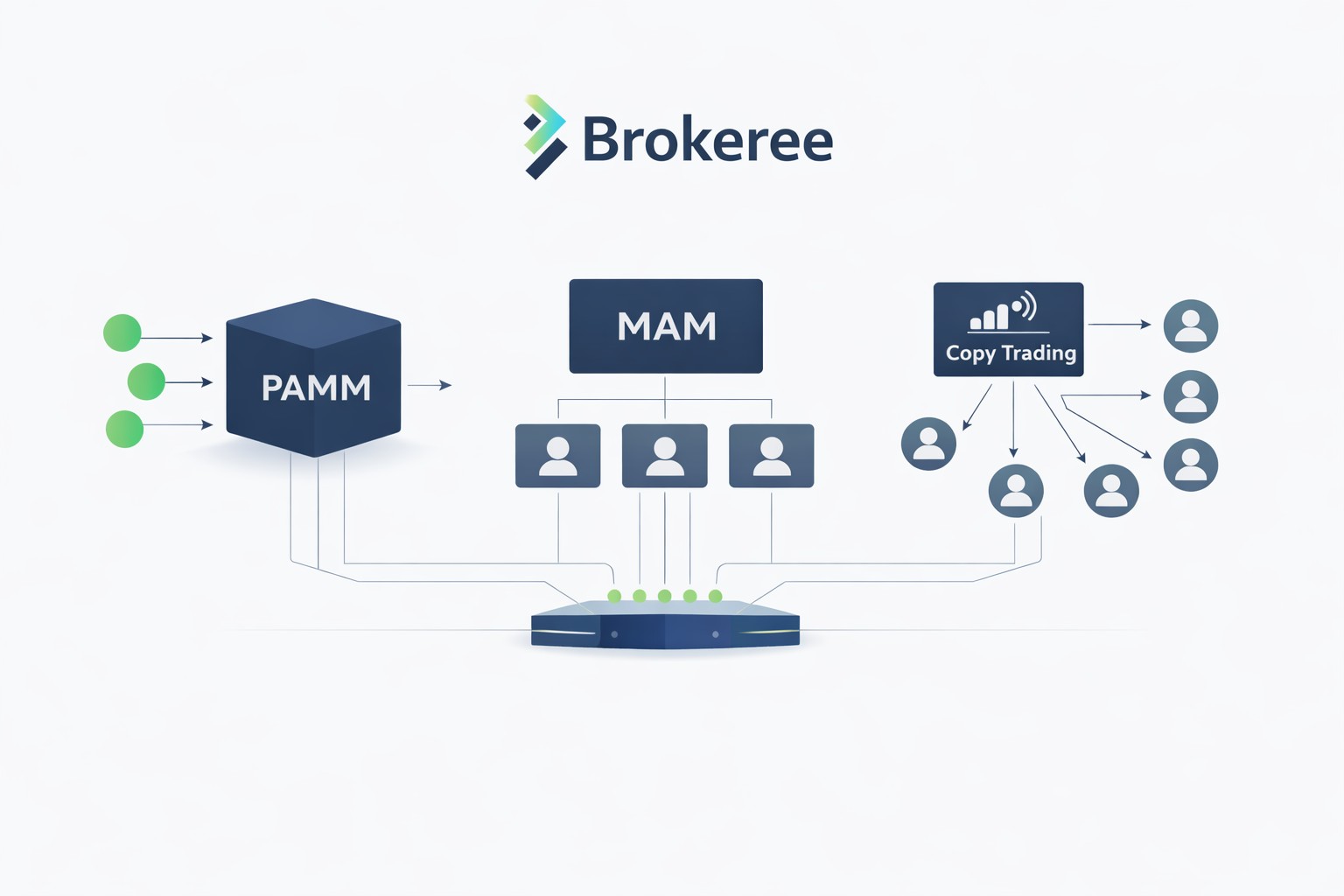
PAMM (Percentage Allocation Management Module) is a pooled investment system. Your clients allocate funds into a shared account managed by a professional trader, called Money Manager or PAMM Manager. The money manager places trades on a master account, and profits or losses are automatically split based on each investor’s percentage contribution.
So, if one investor contributes 20% of the pool and another contributes 50%, the results are distributed in those same proportions. Investors don’t see individual trades. For you as a broker, this setup means trades do not need to be copied across different accounts once the money manager executes the trade on that single master account. That keeps the server load low, which also explains why this model remains effective as brokerage grows. It gets better with high-liquidity instruments like major FX pairs and indices.
Top 5 FAQ about Brokeree PAMM for MetaTrader 4 and 5 - YouTube
Tap to unmute
[Top 5 FAQ about Brokeree PAMM for MetaTrader 4 and 5](https://www.youtube.com/watch?v=xMU2ld0kYyM) [Brokeree Solutions](https://www.youtube.com/channel/UCM0LC5qeiom93uR7aVI1r-w)
Brokeree Solutions442 subscribers
[Watch on](https://www.youtube.com/watch?v=xMU2ld0kYyM)
- ### **MAM: Individual Accounts, Managed Execution**
MAM (Multi-Account Manager) takes a different approach. Funds are not pooled. Instead, a manager trades a master account, and each trade is replicated across individual client accounts using predefined allocation rules. For instance, it could be percentage-based, fixed lot size, or custom ratios.
Here, your clients see every position inside their own accounts, while the manager controls execution. This level of visibility builds trust and supports more advanced strategies.
Social Trading - Why is Copy Trading Popular? - YouTube
Tap to unmute
[Social Trading - Why is Copy Trading Popular?](https://www.youtube.com/watch?v=rpEIsJqbiUE) [Brokeree Solutions](https://www.youtube.com/channel/UCM0LC5qeiom93uR7aVI1r-w)

Brokeree Solutions442 subscribers
[Watch on](https://www.youtube.com/watch?v=rpEIsJqbiUE)
- ### **Copy Trading: Automation with Full Client Control**
Copy trading is the most straightforward model. Trades from a signal provider are automatically copied into followers’ accounts. There’s no pooled capital, and followers remain in complete control, able to stop copying, change risk levels, or close trades at any time.
Unlike PAMM or MAM, copy trading is built for accessibility as it works for every level of trading expertise. It works exceptionally well for beginners and retail traders who want exposure to strategies across FX, crypto, and indices without giving up account ownership.
For brokers, this model is the perfect onboarding and engagement tool. The ease of it for your clients makes it attractive and increases user acquisition. Also, the better chance of positive results boosts client retention. Overall, your trading volumes rise as clients can stay active with minimal effort while you attract more new users.
Essential Steps for a Successful Copy Trading Launch \| @brokeree - YouTube
Tap to unmute
[Essential Steps for a Successful Copy Trading Launch \| @brokeree](https://www.youtube.com/watch?v=xbd4NJl1onU) [Brokeree Solutions](https://www.youtube.com/channel/UCM0LC5qeiom93uR7aVI1r-w)

Brokeree Solutions442 subscribers
[Watch on](https://www.youtube.com/watch?v=xbd4NJl1onU)
Many multi-asset brokers run all three models across MT4, MT5, and cTrader to serve different client segments without fragmenting liquidity.
## **PAMM vs. MAM vs. Copy Trading**
| | | | |
| --- | --- | --- | --- |
| **Feature** | **PAMM** | **MAM** | **Copy Trading** |
| Capital structure | Pooled funds | Individual accounts | Individual accounts |
| | Single master account | Replicated across accounts | Replicated per follower |
| Client trade visibility for investors | Usually no | Yes | Yes |
| Client control | Low | Medium | High |
| Broker scalability | High | High | High |
### Pros and Cons of PAMM for Brokers
For brokers, PAMM offers efficiency and predictability. Trades execute once, capital tends to stay longer, and performance-based fees are easier to manage. These features mean that investors may prefer the PAMM system because it doesn’t require their active participation, encouraging even passive investors to stay.
The downside is reduced transparency for clients who want to see every trade, as well as slippage and liquidity risk.
### Pros and Cons of MAM for Brokers
[**MAM**](https://brokeree.com/articles/empower-your-forex-brokerage-with-pamm-and-mam/) attracts high-value and institutional clients by offering transparency, flexible allocation, and control. It supports complex, multi-asset strategies and meets the expectations of professional money managers.
However, to build this trust, MAM requires a strong infrastructure to handle high trade volumes without slippage or downtime. Also, as a broker, you must enforce strict risk controls and allow only qualified managers, as poor performance directly impacts trust and brand reputation. Clear risk education, realistic performance messaging, and an effective KYC and verification system setup become crucial. Without them, MAM adoption and volumes can suffer.
### Pros and Cons of Copy Trading for Brokers
Copy trading lowers the barrier to entry. It boosts platform activity, fuels community growth, and helps new traders get started quickly.
However, due to the popularity of this service, brokers need a foolproof vetting mecha
This brief was generated from the original reporting. Read the full article at the source:
Read at brokeree.com
Brokeree Solutions