Broker
product
Multi-Asset Trading: How Brokers Build and Scale Diverse Trading Offerings
 Leverate LXCRM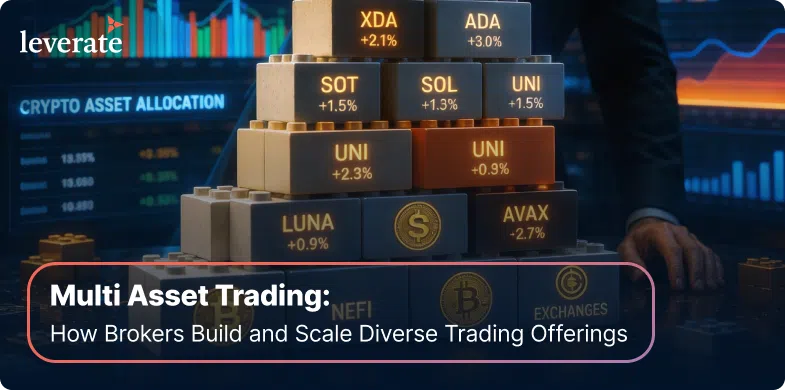

# Multi-Asset Trading: How Brokers Build and Scale Diverse Trading Offerings
- June 1, 2026

# **Multi-Asset Trading: How Brokers Build and Scale Diverse Trading Offerings**
A broker that only offers FX pairs in 2026 is a broker explaining to traders why they need a second account somewhere else. **Multi-asset trading**, the ability to access FX, indices, commodities, equities, crypto, and more from a single platform, is no longer a premium feature. It is the baseline expectation of any trader serious enough to stay on your platform for more than 90 days.
That shift matters commercially. Traders who operate across multiple asset classes deposit more frequently, generate more spread and swap revenue, and churn at a fraction of the rate of single-asset traders. Building a credible **multi-asset trading platform** is not a product decision with long-term payoff. It generates measurable revenue and retention improvements within the first quarter of launch.
The operational challenge is real. Different asset classes require different liquidity relationships, different margin configurations, different rollover mechanics, and different risk frameworks. Brokers who attempt to bolt additional asset classes onto a platform architected only for FX deal with pricing inconsistencies, hedging gaps, and operational overhead that eats the revenue they were trying to capture. This article examines what **multi-asset trading** actually requires at the infrastructure level, and how to build it without manufacturing new operational problems in the process.
## **What Multi-Asset Trading Means for Brokers**
**Multi-asset trading** refers to the ability for traders to access and trade instruments across multiple asset classes from a single account and platform. In the CFD brokerage context, that spans FX currency pairs, equity indices, individual shares, commodities (metals, energies, agriculture), cryptocurrencies, ETFs, and synthetic instruments, all executed through a single interface with unified margin and consolidated position management.
For a trader, the appeal is obvious: diversification, the ability to hedge across correlated markets, and the convenience of managing all positions in one place. For a broker, the mechanics are considerably more involved. Each asset class brings its own pricing source, liquidity profile, session hours, regulatory treatment, and risk characteristics. Offering five asset classes is not five times more complex than offering one; it is exponentially more so. Cross-asset correlations create risk concentrations that single-asset monitoring cannot detect.
### **The Shift From FX-Only to Multi-Asset**
The FX-only brokerage model that dominated retail trading through the 2000s and 2010s has been structurally challenged by a change in trader demographics. According to the Bank for International Settlements, global OTC FX daily turnover reached $7.5 trillion in 2022, a market where retail traders now represent a significant segment. But retail trader interest has diversified substantially alongside crypto adoption, equity market participation driven by zero-commission app-based brokers, and commodity volatility cycles that attract event-driven traders.
Brokers that added asset classes have captured that diversifying interest. Those that stayed FX-only have consistently seen platform stickiness decline as traders maintain accounts on multiple platforms to access what a single FX broker cannot provide. The **multi-asset trading benefits** for the broker are not speculative; they are visible in deposit frequency, session length, and churn metrics.
[Bank for International Settlements — Triennial Central Bank Survey of OTC FX Turnover](https://www.bis.org/statistics/rpfx22.htm)
### **What a Multi-Asset Platform Actually Requires**
Beyond the list of instrument symbols, a genuine multi-asset trading platform requires four things that a standard FX platform does not natively provide: a multi-source liquidity infrastructure capable of pricing each asset class accurately; a risk engine that handles cross-asset correlation and aggregates exposure across instrument types; a margin calculation framework that applies the correct parameters per asset class per regulatory regime; and a back-office system that processes rollovers, corporate actions, and contract specifications without requiring separate manual workflows for each asset type.
| | | | |
| --- | --- | --- | --- |
| **Asset Class** | **Typical Instruments** | **Trading Hours** | **Key Broker Consideration** |
| Forex | 50+ currency pairs | 24/5 | Highest liquidity; tight spreads; rollover/swap management |
| Indices | 14 major indices | 23/5 | Session-specific liquidity windows; gap risk at open |
| Cryptocurrencies | 24 instruments incl. BTC, ETH | 24/7 | Weekend liquidity, volatility spikes, custody/settlement |
| Metals | Gold, Silver, Platinum, Palladium | 23/5 | Safe-haven correlations; macroeconomic event sensitivity |
| Energies | WTI Crude, Brent, Natural Gas | 23/5 | OPEC event risk; inventory data-driven volatility |
| Equities/Shares | 84 global shares; 24/5 via OTC | Market + OTC 24/5 | Corporate action management; earnings event exposure |
| ETFs & Synthetics | Basket instruments | Varies | Pricing model complexity; component liquidity tracking |
## **How Multi-Asset Offering Expands Broker Revenue Streams**
The commercial case for **multi-asset trading** is not built on volume alone; it is built on the revenue architecture that a diversified instrument offering creates. A broker earning exclusively from FX spreads has a single revenue line that contracts whenever volatility is suppressed. A broker with a fully developed **multi-asset trading platform** has multiple revenue streams that are rarely suppressed simultaneously, because different asset classes respond to different macroeconomic conditions.
| | |
| --- | --- |
| **Revenue Source** | **How Multi-Asset Amplifies It** |
| Spread income | More instruments = more spread-generating trades; different asset classes have distinct spread profiles |
| Swap/overnight fees | Per-day swap multipliers by asset class create configurable revenue per position held overnight |
| Commission (A-book) | Higher volume from active cross-asset traders generates more per-lot commission revenue |
| IB/affiliate commissions | Diverse instrument offerings attract more specialist IBs, expanding the partner revenue funnel |
| Deposit velocity | Traders who use multiple asset classes deposit more frequently to maintain diversified margin positions |
| Platform longevity | Multi-asset traders remain active 2–3x longer, compounding lifetime value across all revenue lines |
### **Per-Asset Revenue Configuration**
Each asset class on a **multi-asset trading platform** should be configured as a distinct revenue centre, not a generic extension of FX logic. Swap fees for crypto instruments behave differently from FX rollovers; the 3x Wednesday model that governs FX swap accounting does not apply to 24/7 crypto positions. Indices have gap risk at session opens that FX positions rarely create. Equities require corporate action processing for dividends and splits that have no FX equivalent.
Leverate’s Broker Portal allows brokers to configure per-day swap multipliers per asset class, setting different fee logic for crypto, indices, commodities, and FX from a single dashboard with no development work.
| |
| --- |
| _“It’s about giving brokers the power to match their pricing to real trader activity, which is increasingly global, 24/7, and multi-asset.”_ **— Leverate insights** |
This brief was generated from the original reporting. Read the full article at the source:
Read at leverate.com