News website
technology
Link Building in the Age of AI Search: What Changes, What Doesn’t
 Bazoom Group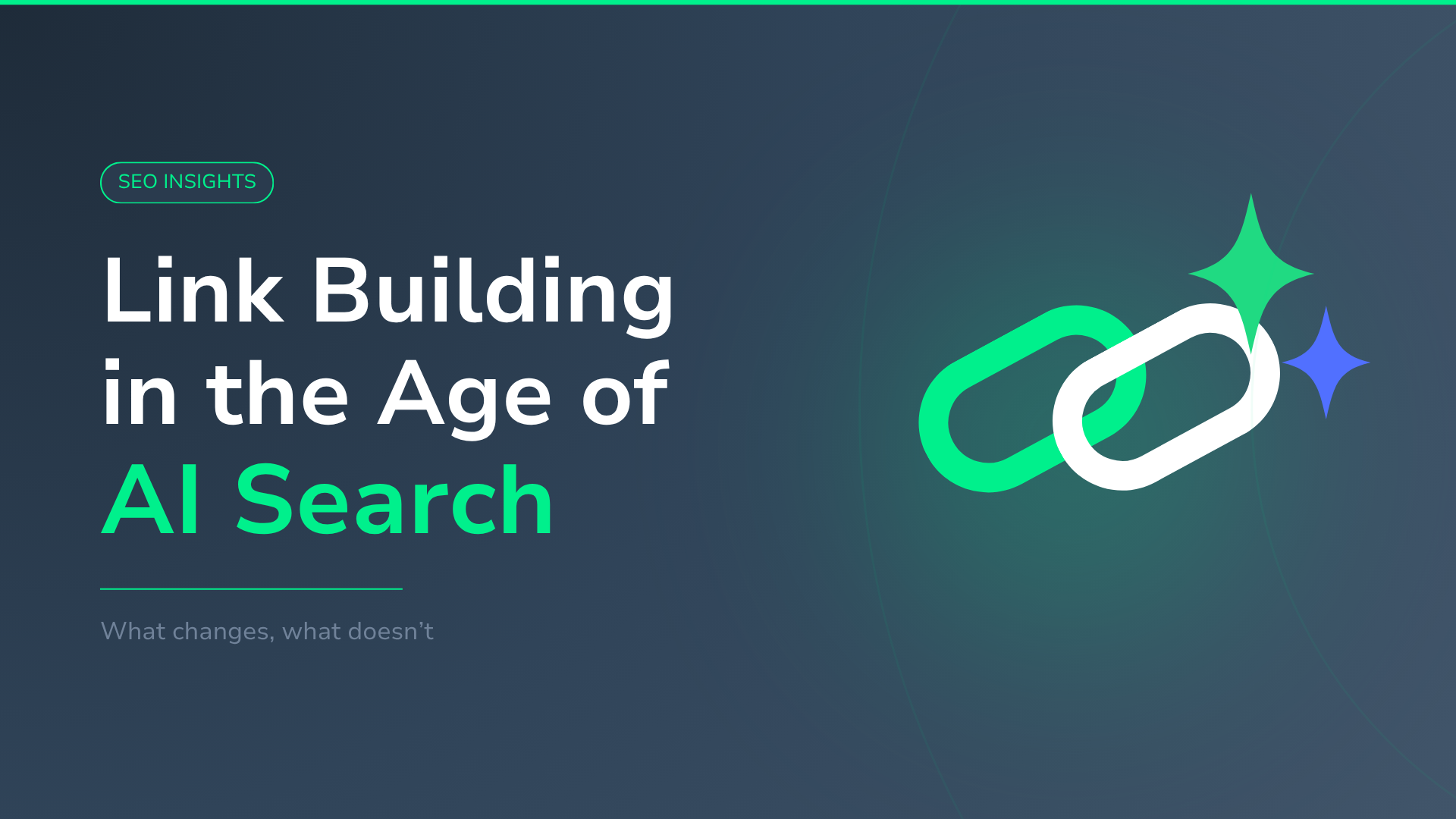
# Link Building in the Age of AI Search: What Changes, What Doesn’t
June 4, 2026 [Tamara Novitović](https://bazoom.com/author/tamaranovi/)Comments Off on Link Building in the Age of AI Search: What Changes, What Doesn’t

Jump to section \[Open\]
- [1 What actually changed in AI search](https://bazoom.com/ai-link-building/#What-actually-changed-in-AI-search)
- [2 Where links sit in the AI pipeline](https://bazoom.com/ai-link-building/#Where-links-sit-in-the-AI-pipeline)
- [3 What doesn’t change (and why people keep getting this wrong)](https://bazoom.com/ai-link-building/#What-doesnt-change-and-why-people-keep-getting-this-wrong)
- [4 The signals that matter more now](https://bazoom.com/ai-link-building/#The-signals-that-matter-more-now)
- [5 What stops working](https://bazoom.com/ai-link-building/#What-stops-working)
- [6 A practical AI link building playbook](https://bazoom.com/ai-link-building/#A-practical-AI-link-building-playbook)
Every few years the [SEO](https://bazoom.com/organic-seo/ "Our guide on how to master organic optimization") industry declares [link building](https://bazoom.com/ "Bazoom") dead. Panda was going to kill it. Penguin was going to kill it. Now AI search is supposedly going to kill it. Here is the part nobody selling you a _“GEO course”_ wants to say out loud: the mechanics barely changed. The interface did.
ChatGPT, Perplexity, Gemini and Google AI Overviews do not pull answers out of thin air. They retrieve from the same web that ranks in classic search, and they lean on many of the same trust signals. Links are one of those signals. So the real question is not whether **ai link building** matters. It is which links move the needle now, and which ones were always noise.
I will keep this grounded in data, not vibes. We recently analyzed 3 million URLs across traditional SERPs, Google AI Mode and ChatGPT citations. The pattern was consistent: authority gets you into the pool, content quality gets you cited. Tactics that claimed to be _AI-specific_ mostly did neither.
> ☰
>
> What you’ll learn in this guide
>
> →What AI search changed about how links are read and ranked
>
> →The link-building principles AI hasn’t touched (and won’t)
>
> →Which signals matter more now: brand mentions, citations, consistency
>
> →The tactics that stopped working
>
> →A practical playbook for AI search visibility
## **What actually changed in AI search**
Classic search and AI search share a backend. Both crawl, both index, both rank candidate pages. The difference is the last step.
A SERP hands you ten blue links and lets you choose. An AI answer reads a shortlist of sources, synthesizes them, and cites a few. You are no longer competing for a click. You are competing to be one of the three or four sources the model decides to trust enough to quote.
That shift changes the economics of a link without changing its function:
- A link still passes authority. That has not changed.
- Authority still decides whether you enter the retrieval pool. Also unchanged.
- But the final selection now rewards clarity, structure and corroboration across sources, not just the page with the most [backlinks](https://bazoom.com/backlinks/ "Backlinks: Your roadmap to greater visibility").
Layer 1 — Retrieval pool entryWho even gets considered as a source[Editorial links](https://bazoom.com/editorial-links/ "Use editorial links to build authority and credibility")Domain trustSite agefilters down to a shortlistLayer 2 — Citation selectionWho actually gets quotedContent qualityBrand mentionsLinks get you into the pool. Everything else gets you cited.
## **Where links sit in the AI pipeline**
| **Stage** | **What happens** | **Does it use links?** | **What wins here** |
| --- | --- | --- | --- |
| **Crawl & index** | Page discovered and stored | **Yes — discovery** | Crawlability, internal links |
| **Retrieval pool** | Candidate sources shortlisted | **Yes — authority signal** | Domain trust, backlinks |
| **Synthesis** | Model reads & combines sources | Indirectly | Clear, structured content |
| **Citation** | A few sources get quoted | Indirectly | Quality, corroboration, brand |
Read that table top to bottom. Links dominate the first half of the pipeline and fade in the second. That is the whole story of **ai link building** in one frame: links are your entry ticket, not your closing argument.
## **What doesn’t change (and why people keep getting this wrong)**
The “links don’t matter anymore” crowd makes one mistake. They watch the citation step, see content quality winning, and conclude links are obsolete. They missed the step before it, where you either made the shortlist or you didn’t.
Three things hold steady from classic SEO into AI search:
1. **Authority still gates visibility.** Low-authority domains rarely enter the retrieval pool, no matter how good a single page is.
2. **Editorial, [relevant links](https://bazoom.com/relevant-backlinks-explained-strategies-to-enhance-your-link-profile/ "Relevant backlinks: Your roadmap to sustainable SEO") still build that authority faster than anything else.** A relevant placement from a trusted publisher is still the cleanest signal you can send.
3. **Spam still gets ignored.** AI systems are, if anything, less tolerant of low-quality link patterns because they cross-reference brand signals the link graph alone can’t fake.
**Reality check** Search engines have repeatedly confirmed that links remain a core ranking signal. According to [Google’s own Search guidance](https://developers.google.com/search/docs/fundamentals/seo-starter-guide), links help discovery and signal relationships between pages. Nothing in the move to AI answers reversed that.
## **The signals that matter more now**
Here is where AI search genuinely shifts the priority list. The link is still useful, but the context around it carries more weight than it used to.
### **1\. Unlinked brand mentions**
AI systems pattern-match on how often and where a brand shows up, not just on hyperlinks pointing at it. A brand named repeatedly across credible sources reads as a real entity. That is why **brand mentions seo** stopped being a soft metric and became a retrieval input.
chatgpt.com

ChatGPT names Tir Na nÓg as the top pub in Aarhus with no link attached. The mention itself is the visibility.
A hyperlink passes authority. A brand mention builds entity recognition. You want both, and most link programs only buy the first.
### **2\. Citation-worthy content**
Models cite sources that are easy to extract from: clear claims, original data, defined terms, clean structure. This is the part people rebrand as **answer engine optimization**, but it is mostly just good content engineering that classic SEO always rewarded.
### **3\. Topical consistency**
A domain that covers one subject deeply and links out and in around that subject builds a clearer topical fingerprint. AI retrieval favors sources that are recognizably about something.
### **Signal scorecard**
| **Signal** | **Classic SERP weight** | **AI search weight** |
| --- | --- | --- |
| **Editorial, relevant links** | **High** | **High** |
| **Raw backlink volume** | Medium-High | Medium |
| **Unlinked brand mentions** | Low-Medium | **High** |
| **Content structure & clarity** | Medium | **High** |
| **Topical consistency** | Medium | **High** |
| **“GEO-specific” hacks** | **None** | **None** |
## What stops working
If some signals rise, others fall. These are the tactics I would stop funding.
- **Volume-first link buying.** A thousand low-relevance links used to move rankings on momentum. AI retrieval cross-checks brand and topical signals, so that momentum fizzles.
- **Exact-match anchor stuffing.** Over-optimized anchors look engineered to every system reading the link graph now.
- **“GEO” and “AEO”
This brief was generated from the original reporting. Read the full article at the source:
Read at bazoom.com