Broker
product
How Leverate’s Free Tier Changes the Economics of Starting a Brokerage
 Leverate LXCRM

# How Leverate’s Free Tier Changes the Economics of Starting a Brokerage
- June 9, 2026

# **How Leverate’s Free Tier Changes the Economics of Starting a Brokerage**
Starting a brokerage has traditionally required a serious upfront technology commitment before the business could prove demand. That has kept many capable operators stuck in planning mode.
Leverate’s free tier changes the starting point. New brokers and adjacent financial operators have the opportunity to access core brokerage infrastructure, onboard real traders, and grow when the business case is clearer. The launch model becomes more practical: start lean, test the market, and grow when the operation justifies it. While testing the waters used to be costly, [Leverate](https://leverate.com/) provides the opportunity to start with bootstrapped finances. Here’s how.
## **Key Takeaways**
- The traditional brokerage launch model required heavy upfront spend across platform, CRM, liquidity, hosting, payments, and support.
- Leverate’s free tier lowers the entry barrier with essential brokerage tools and services from the get-go.
- The fast go-live model helps brokers move from planning to real trader onboarding in days, subject to documentation and approval.
- The free tier is built for serious market testing by new entrants, aspiring brokers, regional financial operators, and prop firms exploring CFD expansion.
## **The Old Model vs. the New Model: Why Brokerage Launch Barriers Are Falling**
The old brokerage launch model placed most technology investment at the start. A broker often had to secure a trading platform, arrange hosting, connect liquidity, configure [CRM workflows](https://www.salesforce.com/crm/what-is-crm/), set up payments, plan client onboarding, manage IB structures, and coordinate several providers before knowing whether the market would respond.
That created a difficult timing problem. The broker had to spend before answering basic commercial questions: Can we acquire traders? Can we retain them? Does our region or niche respond to this offer?
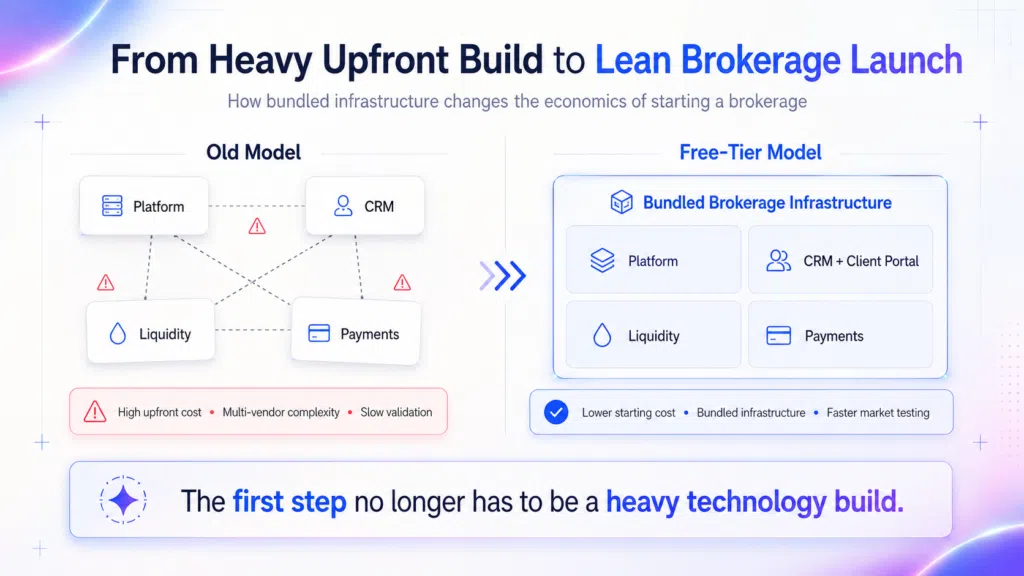
Cost was only part of the problem. A multi-vendor setup also meant more contracts, integrations, technical dependencies, and support gaps. Even a well-planned launch could become a long chain of platform setup, CRM configuration, liquidity coordination, payment testing, and operational preparation.
Commitment added another layer of hesitation. Many aspiring brokers did not want to lock themselves into a large technology stack before they had proof of demand.
The free-tier model lowers that pressure. Instead of assembling the stack manually, brokers can start with bundled infrastructure. Leverate’s free tier gives access to a trading platform, operational tools, and trader-facing functionality without forcing a large initial technology commitment.
Brokerage operations still require regulatory readiness, acquisition strategy, risk oversight, customer support, and proper business planning. But technology access no longer has to be the first major obstacle.
## **Exactly What the Free Tier Includes**
A free brokerage tier only matters if it includes enough infrastructure to run a meaningful test. Leverate’s free tier includes core components across the trading, operational, and engagement layers.
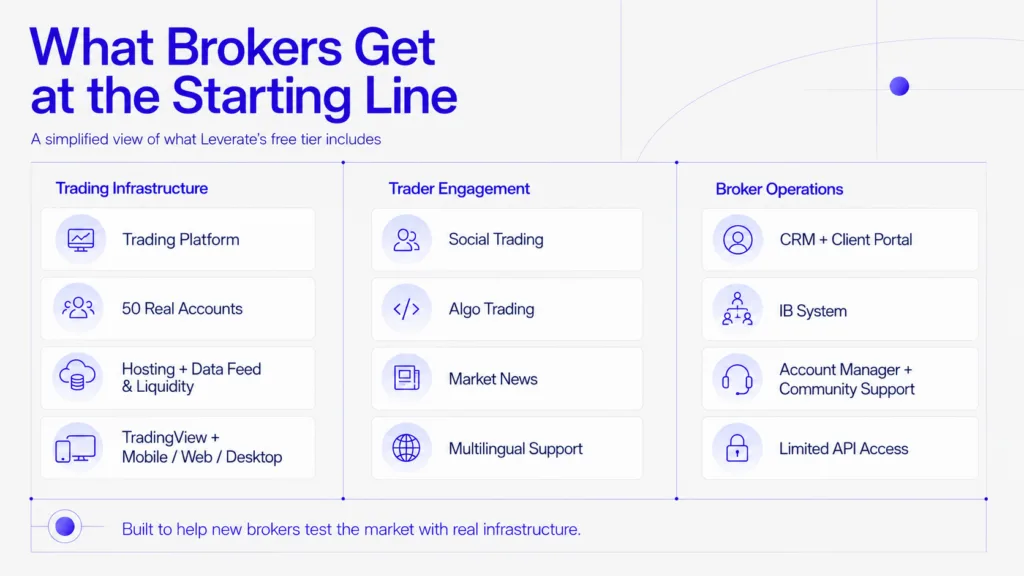
On the trading side, the tier includes the trading platform, branded trading platform access, 50 real accounts, one group, read-only manager access, data feed and liquidity, hosting, mobile, web, and desktop access, [payment processor support](https://www.investopedia.com/terms/p/payment-gateway.asp), TradingView charts, multilingual support, calendar and market news, unlimited instruments, and limited API access.
This stack provides enough infrastructure to test the operating flow: account access, platform experience, market data, trader onboarding, and execution.
The free tier also includes trader engagement tools. [Social trading](https://www.binance.com/en/academy/glossary/social-trading) and algorithmic trading give the platform more depth than basic order placement. New brokers need reasons for users to return, explore, and stay active. These tools help test whether the broker can build engagement around more than market access alone.
On the operations side, the free tier includes CRM and Client Portal access, with limited access. It also includes one CRM seat, limited agent permissions, IB system access, limited API/database access, an account manager, and community support.
The limitations matter. This is a starting tier, not an unlimited enterprise package. Its value comes from giving brokers enough structure to validate the business without paying for full-scale infrastructure too early.
The pricing model also keeps the commercial boundaries visible. The free tier has no setup fee and no commitment period, while additional services and paid tiers are listed separately.
**The 4-to-6-Day Go-Live Model: From Setup to Real Trader Onboarding**
Launch speed matters because it reduces the distance between decision and real world results. A broker can spend months planning, comparing tools, and revising projections. None of that proves whether traders will open accounts, deposit, engage, or stay active.
Leverate’s fast go-live model is designed to shorten that waiting period. The homepage terms refer to delivery within up to 5 business days, subject to agreement signing and approval of company documents. In practice, readiness depends on documentation, approval, and clean onboarding.
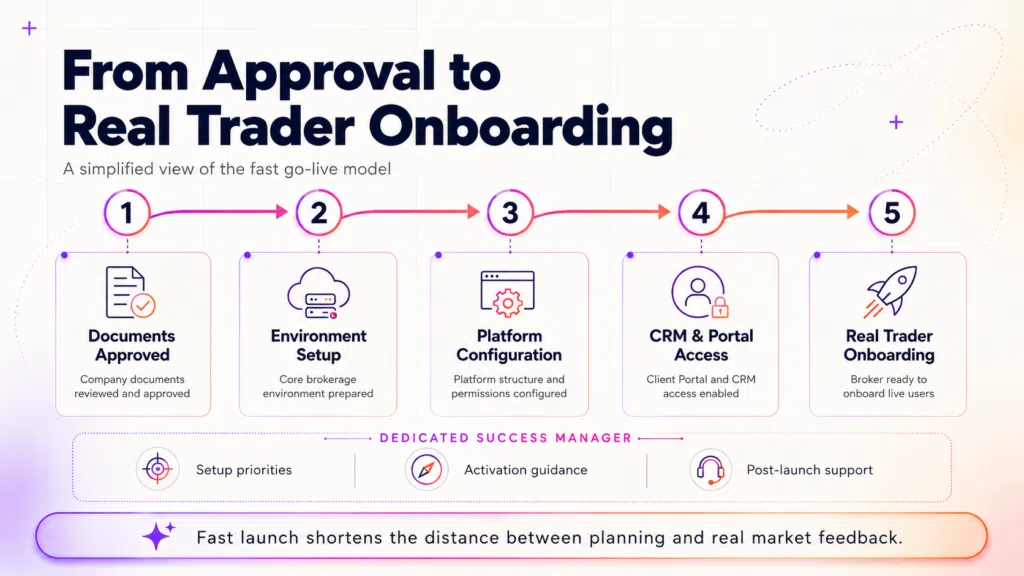
A brokerage environment still has several moving parts. The platform must be configured, account structure defined, permissions set, CRM and Client Portal access prepared, and payment and onboarding flows understood.
A dedicated success manager helps reduce friction during this process. During launch, the success manager can clarify setup priorities, guide activation steps, and help the broker understand what must be ready before real trader onboarding begins.
After launch, guidance remains useful because the first days of activity reveal operational gaps quickly. Traders ask questions. Account flows may need adjustment. Internal teams learn which processes work and which ones need tightening.
Fast launch is useful because it gets the broker closer to market feedback. Instead of spending months assembling infrastructure, the broker can begin testing acquisition, onboarding, engagement, and operational readiness.
## **When and How to Scale: Transparent Tier Progression Without Early Lock-In**
The free tier is a launch and validation model. It is not designed to cover every growth scenario forever.
A broker will know it is time to scale when operational demand exceeds the limit
This brief was generated from the original reporting. Read the full article at the source:
Read at leverate.com