CRM
product
Generic CRM vs Forex CRM: Why Brokers Need a Specialized System
### Table of Contents
- [Why Do Many Brokers Start With a Generic CRM?](https://www.hashcodex.com/generic-crm-vs-forex-crm#why-do-many-brokers-start-with-a-generic-crm)
- [Where Generic CRMs Start Creating Problems for Forex Brokers](https://www.hashcodex.com/generic-crm-vs-forex-crm#where-generic-crms-start-creating-problems-for-forex-brokers)
- [Why Do Forex Brokers Need Specialized Forex CRM Software?](https://www.hashcodex.com/generic-crm-vs-forex-crm#why-do-forex-brokers-need-specialized-forex-crm-software)
- [Forex CRM vs Generic CRM: Key Differences](https://www.hashcodex.com/generic-crm-vs-forex-crm#forex-crm-vs-generic-crm-key-differences)- [When Should a Broker Upgrade to a Forex CRM?](https://www.hashcodex.com/generic-crm-vs-forex-crm#when-should-a-broker-upgrade-to-a-forex-crm) - [Final Words](https://www.hashcodex.com/generic-crm-vs-forex-crm#final-words)
### Table of Contents
- [Why Do Many Brokers Start With a Generic CRM?](https://www.hashcodex.com/generic-crm-vs-forex-crm#why-do-many-brokers-start-with-a-generic-crm)
- [Where Generic CRMs Start Creating Problems for Forex Brokers](https://www.hashcodex.com/generic-crm-vs-forex-crm#where-generic-crms-start-creating-problems-for-forex-brokers)
- [Why Do Forex Brokers Need Specialized Forex CRM Software?](https://www.hashcodex.com/generic-crm-vs-forex-crm#why-do-forex-brokers-need-specialized-forex-crm-software)
- [Forex CRM vs Generic CRM: Key Differences](https://www.hashcodex.com/generic-crm-vs-forex-crm#forex-crm-vs-generic-crm-key-differences)- [When Should a Broker Upgrade to a Forex CRM?](https://www.hashcodex.com/generic-crm-vs-forex-crm#when-should-a-broker-upgrade-to-a-forex-crm) - [Final Words](https://www.hashcodex.com/generic-crm-vs-forex-crm#final-words)
When brokers start looking for a CRM, the choice often comes down to two options:
**A Generic CRM or a Forex CRM.**
At first, both may seem similar because they help store client information and track communication. However, the needs of a forex brokerage go much further than basic customer management.
A broker also needs to handle KYC verification, AML checks, trading accounts, deposits, withdrawals, compliance records, and partner management.
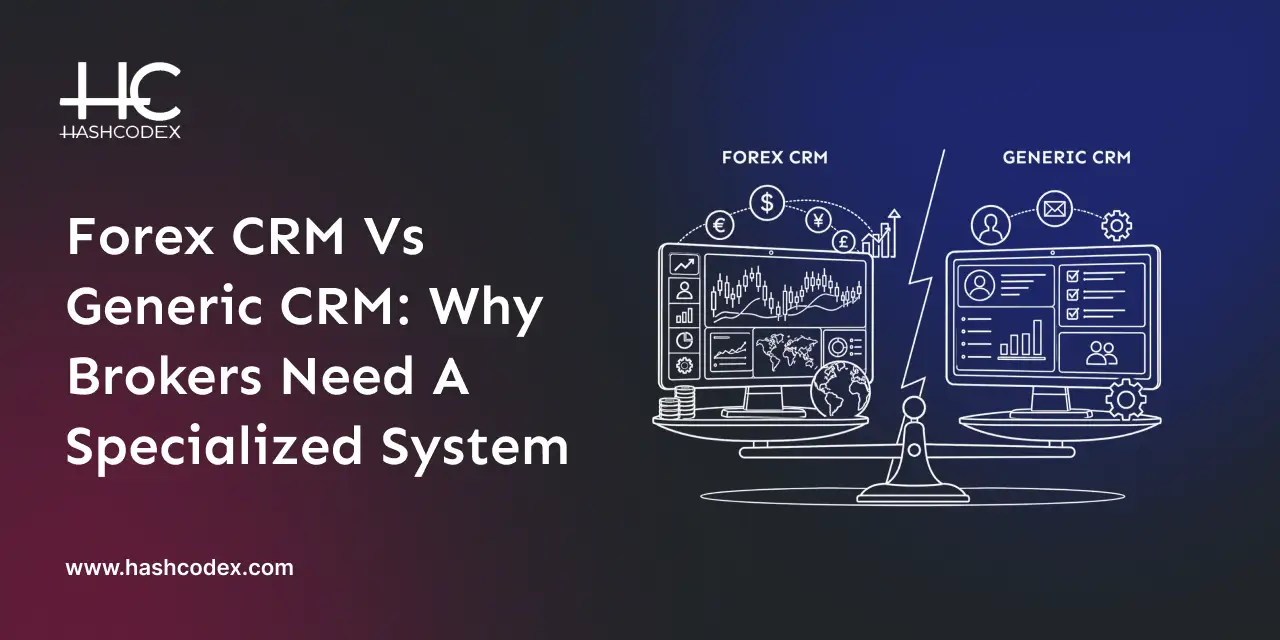
This is where the difference becomes clear. While a generic CRM is built for a wide range of businesses, a Forex CRM is designed specifically for brokerage requirements.
In this guide, we will compare Forex CRM vs Generic CRM and explain why many brokers eventually move to a specialized system as their business grows.
## Why Do Many Brokers Start With a Generic CRM?
Many brokers start with a generic CRM because it covers the basics they need in the early stages. It stores client information, tracks leads, and records communication, which is often enough when client numbers are low.
Cost is another reason. These platforms are widely available and require a lower initial investment, which makes them attractive for new brokerages.
But the real challenge comes later. As the brokerage grows, KYC checks, AML screening, compliance tracking, and trading management become part of daily work, and the limits of a generic CRM start to show.
## Where Generic CRMs Start Creating Problems for Forex Brokers
Forex brokers need specialized Forex CRM software because their operations go beyond basic customer management. They deal with trading activity, compliance requirements, and partner networks all at the same time, which generic CRM systems are not built to handle.
**→ One of the main gaps is trading platform integration**
Most generic CRMs do not connect with MT4 or MT5. Trading activity stays outside the CRM, so teams cannot clearly see real time client behavior or account movements. This creates a disconnect between CRM data and actual trading performance.
**→ Compliance and KYC tracking become harder to manage**
Verification documents and regulatory checks are usually handled in a basic way. Many brokers end up doing these tasks manually or using separate tools, which slows down operations as client numbers grow.
**→ Affiliate and IB tracking is not efficient**
Commission structures and partner reporting are not properly built into the system. Because of this, teams often depend on spreadsheets or external tools, which takes more time and increases the chance of mistakes.
**→ Data becomes scattered across systems**
Different teams work in different tools for sales, support, finance, and compliance. This makes it difficult to get a single clear view of the client journey.
## Why Do Forex Brokers Need Specialized Forex CRM Software?
Forex brokers need specialized Forex CRM software because their operations go beyond basic customer management. They deal with trading activity, compliance requirements, and partner networks all at the same time, which generic CRM systems are not built to handle.
**Trading Platform Connection**
A Forex CRM connects directly with trading platforms like MT4, MT5, or cTrader. This lets brokers see trading activity in real time, like account balance, open trades, and trading volume, all in one place. It saves time because everything is visible in a single system.
**KYC and Compliance Handling**
Forex brokers need to follow KYC and AML rules. A specialized CRM helps by checking documents and handling onboarding in a simple way. It also helps teams keep track of compliance without confusion or extra manual work.
**Affiliate and IB Management**
Brokers often work with affiliates and introduce brokers to bring in clients. A Forex CRM tracks who brought which client, calculates commissions, and helps manage payouts automatically. This removes the need for spreadsheets.
**Wallet and Payments**
Forex CRMs usually have a built-in wallet system. This helps manage deposits, withdrawals, and transfers easily in one place linked with trading accounts.
**Client Activity Tracking**
The system also shows how clients are behaving, like how often they trade or if they stop trading. This helps brokers take action at the right time.
**Also Read:** **[Why Forex Businesses Choose a CRM to Grow](https://www.hashcodex.com/why-forex-business-needs-crm)**
# **Forex CRM vs Generic CRM: Key Differences**
Let’s put it simply. A generic CRM and a forex CRM are not the same thing at all. One is just for normal customer management, and the other is built for forex brokers who deal with trading, clients, and partners every single day.
**A Generic CRM Focuses on Sales. A Forex CRM Focuses on Brokerage Operations**
Let’s keep this simple. A generic CRM is mainly used to manage leads and customer relationships. It helps you store contacts, track conversations, and follow up on sales activity.
But if you are running a forex brokerage, things are not just about sales. You are also handling trading accounts, client verification, deposits, withdrawals, and partner networks. So a basic sales tool quickly feels limited. That is where a forex CRM comes in.
**When client data needs to go beyond basic details**
In a generic CRM, you mostly see simple information like name, email, and communication history.
In a forex CRM, the same client is linked with their trading activity. So you are not just looking at who the client is, but also what they are doing inside their account, all in one place.
**When daily operations start to feel scattered**
At the beginning, one system is usually enough. But as the brokerage grows, different teams start working in different ways.
Sales, support, finance, and compliance all deal with the same client, but often in separate tools. This is when things start to feel disconnected. A forex CRM helps bring everything together so teams are not working in isolation.
**When compliance and partner work become part of daily flow**
Compliance is not just storing documents, and affiliates are not just tracking names.
A generic CRM handles only basic storage. A forex CR
This brief was generated from the original reporting. Read the full article at the source:
Read at hashcodex.com